Why get organised now
French workshops are growing. According to the “2025 key figures” published by Francéclat in February 2026 (see the guide’s sources), French jewellery production reached €6,162 million excluding VAT in 2025, up 8%, with 12,064 people; the body mentions 50,000 m² of new workshops in five years.
More pieces in progress means more metal circulating and more hands passing work on: modelmaker, mounter, stone setter. What used to fit in the head of the workshop manager no longer does.
Eight markers, from order to returned piece
One record per job
Creation, resizing, stone setting, repair: each job has its record, with the piece, what needs doing, the due date and the person in charge. The test: can a colleague take over the job tomorrow morning without calling you?
A bill of materials
Write down what the piece is meant to consume: metal by the gram, stones, findings, hours. This is your planned cost, and the point of comparison for what follows.
Material reserved before starting
The gold wire promised to one order must not go to another. Set aside what each job will consume; if material is missing, better to know before launching.
Steps, and a proof for each step
A photo at intake and at delicate steps is worth more than a long report. In a dispute over a stone or a scratch, it settles the matter.
A second pair of eyes
Before returning the piece, have it checked by someone other than the person who made it. We do not see our own flaws.
Weighing at exit
Compare what the piece actually consumed with the bill of materials. Filings, scrap, breakage: a discrepancy can almost always be explained, provided you look at it the same day. Scrap is weighed and goes back to stock.
Repairs kept apart
The piece is not yours. Photos at intake, the reason noted in the customer’s own words, brought-in metal weighed in front of them, quote accepted before starting.
One review a week
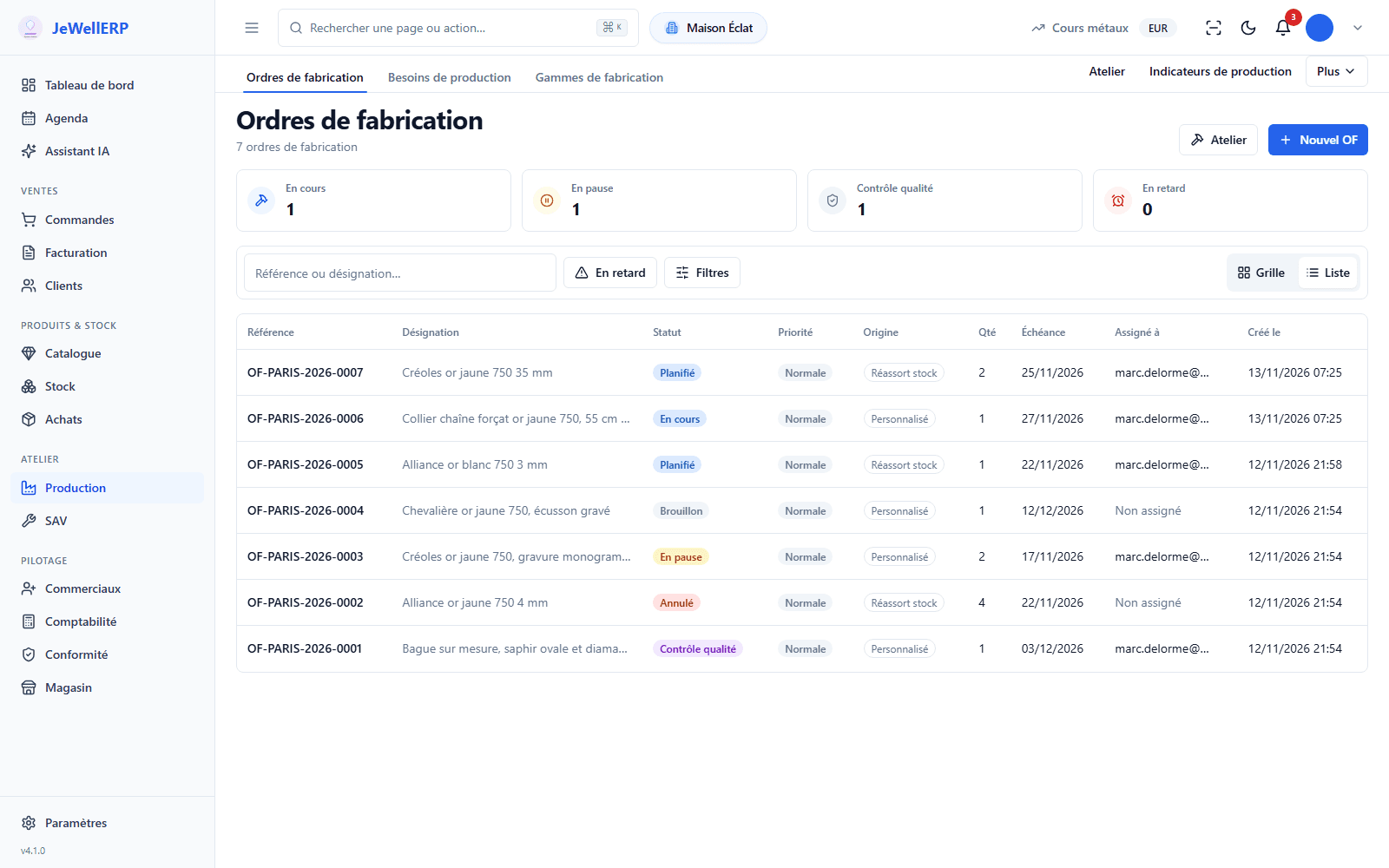
Four questions are enough: what is in progress, paused, in quality control, late?
An example of planned cost
| Item | Quantity | Unit price | Cost |
|---|---|---|---|
| Gold | 4 g | €52 per gram | €208 |
| Workshop | 1 h | €50 per hour | €50 |
| Planned total | €258 |
If weighing at exit shows 4.6 g consumed instead of 4 g, the actual cost rises to €289.20. Without weighing, you would never have known; with it, you can look for where the 0.6 g went.