What the register must show
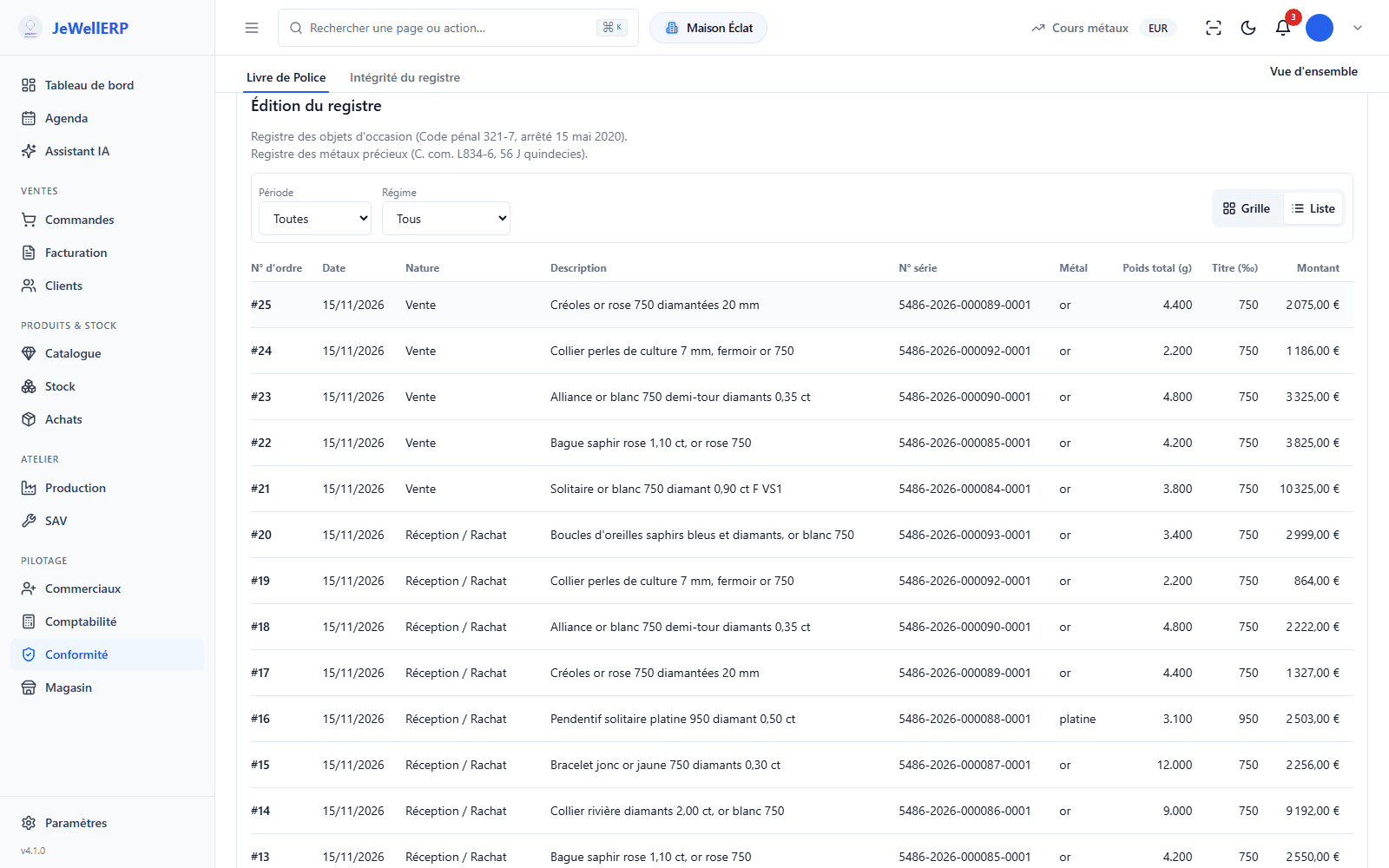
On its page “Tenir un livre de police” (“Keeping a police book”), the French customs authority describes a register of the purchases, sales, receipts and deliveries of precious-metal articles. The idea fits in one sentence: for every article that comes in or goes out, you must be able to say where it came from, what it is and where it went.
In a jewellery shop, two registers often overlap: the one for precious metals and the one for second-hand goods. If you buy back jewellery, both registers may concern you: ask your adviser or your assay office how to keep them.
Paper or software: what customs says
The same page states that the register may take the form of a paper register, secure software or the accounts. It also specifies that it is neither registered nor approved by customs.
References to legal texts change. Before citing an article of law in your documents, check it at the source or with your adviser.
Six habits that avoid trouble
A single entry
The piece is described once, when it enters stock, and the register takes up that description. Two entries mean two chances to make a mistake.
A precise description
Type of article, metal, fineness in thousandths, weight. “Gold ring” is not enough to recognise a piece six months later.
The origin noted on entry
Purchase from a supplier, second-hand purchase from a private individual, piece left for a repair: note where the article comes from at the moment it comes in, not afterwards.
Never correct by overwriting
A mistake is corrected by a new entry that cancels the first. A line that is erased or rewritten casts doubt on the whole register.
A reconciliation with the stock
At each stocktake, compare what the register says with what is in the window and the safe. A discrepancy is dealt with the same day.
An export kept separately
Export the register at regular intervals, and store the copy somewhere other than the shop’s workstation.
How long should it be kept?
The customs page we read gives no duration, and the other sources consulted do not agree with each other. Put the question to your accountant or to your assay office (French bureau de garantie), and keep their answer in writing.
Seven questions to ask a software vendor
- Is the register filled in by stock movements, or does it have to be re-keyed?
- Can an entry be edited after the fact? If so, does it show?
- How is a mistake corrected?
- In what form is the register exported, and who is allowed to export it?
- What happens to a piece whose origin is not filled in?
- Is metal left by a customer for a repair tracked?
- Can I take the whole register with me if I change software?